Water changes how filmmakers capture light, sound, movement, and risk: as a reflective surface, a refracting medium, and a force that can obscure equipment or endanger a crew. In practical terms, filming near or under water means planning for altered optics, specialized camera housings, controlled lighting, and stricter safety procedures. These effects matter across underwater cinematography, rain and surface filming, and water-based production design. The stakes are real: the National Oceanic and Atmospheric Administration estimates that the ocean covers about 71% of Earth’s surface, while the U.S. Bureau of Labor Statistics reports that 5,283 workers died from work-related injuries in the United States in 2023—one reason production teams must treat water work as a safety discipline, not just an aesthetic choice.
Water changes the visual properties of filmmaking
Water’s influence on an image begins with its interaction with light. The American Academy of Underwater Sciences describes underwater photography as a specialized practice shaped by light loss, color absorption, refraction, and suspended particles. In filmmaking, these properties affect exposure, focus, color, framing, and the apparent distance between camera and subject.
Refraction and apparent distance
Refraction is the bending of light as it passes between materials, such as air, a camera’s flat port, and water. Because light travels differently through water and air, objects viewed underwater through a flat port can appear larger and closer than they really are. A dome port helps preserve a wider field of view by creating an air space in front of the lens, but it requires careful positioning and focus. These optical differences make lens choice and camera-to-subject distance especially important: a composition that seems spacious on land may feel compressed underwater.
Color loss and underwater lighting
Water absorbs and scatters light, and longer wavelengths such as red generally disappear sooner than blue. The result is a cool, low-contrast image at depth, even when the scene looks colorful to a diver using a light. NOAA oceanographic material explains that water clarity and light availability vary with depth and with particles in the water. For film crews, this means that white balance alone cannot restore color that never reaches the camera: lights, close subject distances, filters, or deliberate color grading may be necessary. A useful production diagram would compare the visible spectrum at the surface with the progressively bluer spectrum at depth.
Turbidity, backscatter, and visibility
Turbidity is the cloudiness of water caused by suspended matter, including sediment, plankton, or organic material. Those particles scatter light; when a camera light illuminates particles close to the lens, they can appear as bright flecks called backscatter. The U.S. Geological Survey identifies suspended particles as a factor that affects water clarity. To limit backscatter, cinematographers often place lights off-axis, keep them away from the lens, and avoid stirring sediment. Clear water is not merely attractive scenery—it directly determines how far the camera can see and how much contrast the image can retain.
Water reshapes camera movement and sound
Once the visual conditions are understood, water changes the physical language of a shot. Buoyancy, drag, waves, and pressure affect camera movement, while water transmits sound differently from air. These properties create distinctive cinematic possibilities, but they also make repeatable takes and precise synchronization more difficult.
Buoyancy, drag, and underwater movement
Buoyancy is the upward force exerted by a fluid on an immersed object; drag is resistance to movement through that fluid. Together, they change how a camera operator and housing move. A neutrally buoyant rig can hover steadily, while a poorly balanced system may rise, sink, or rotate. Water resistance also slows starts and stops, giving underwater motion a floating quality that can suggest weightlessness or dreamlike suspension. The same resistance makes fast pans and tracking moves harder to control, so crews commonly rehearse movements and balance the rig before recording.
Surface movement, waves, and reflections
At the surface, waves continually change reflections, horizon lines, and the angle of incoming light. A small change in camera height can turn a transparent view into a mirror-like reflection, while wind-driven ripples can break up reflections into moving highlights. Filmmakers can use this instability for mood or visual texture, but continuity becomes challenging when matching shots across changing weather or water conditions. A practical shot log should record wind, tide, sun position, and water state alongside lens and exposure settings.
Sound underwater and at the waterline
Sound behaves differently underwater because it travels through water rather than air, and microphones designed for ordinary production audio are not automatically suitable for submerged recording. Dialogue is often captured with above-water microphones or recorded separately, while underwater sequences may rely on purpose-built hydrophones, effects, and post-production sound design. The National Park Service’s underwater sound research describes how sound propagates through aquatic environments and how human activity can contribute noise. For filmmakers, the lesson is to plan sound capture as its own system rather than assuming that an underwater camera setup will also deliver usable production audio.
Water requires specialized equipment and production planning
The optical and physical effects of water lead directly to equipment and workflow choices. A camera that works reliably on land may fail if water reaches its seals, connectors, or battery compartment. Underwater production therefore combines camera housing, lens-port selection, lighting, communications, and testing into one integrated setup.
Housings, ports, and pressure
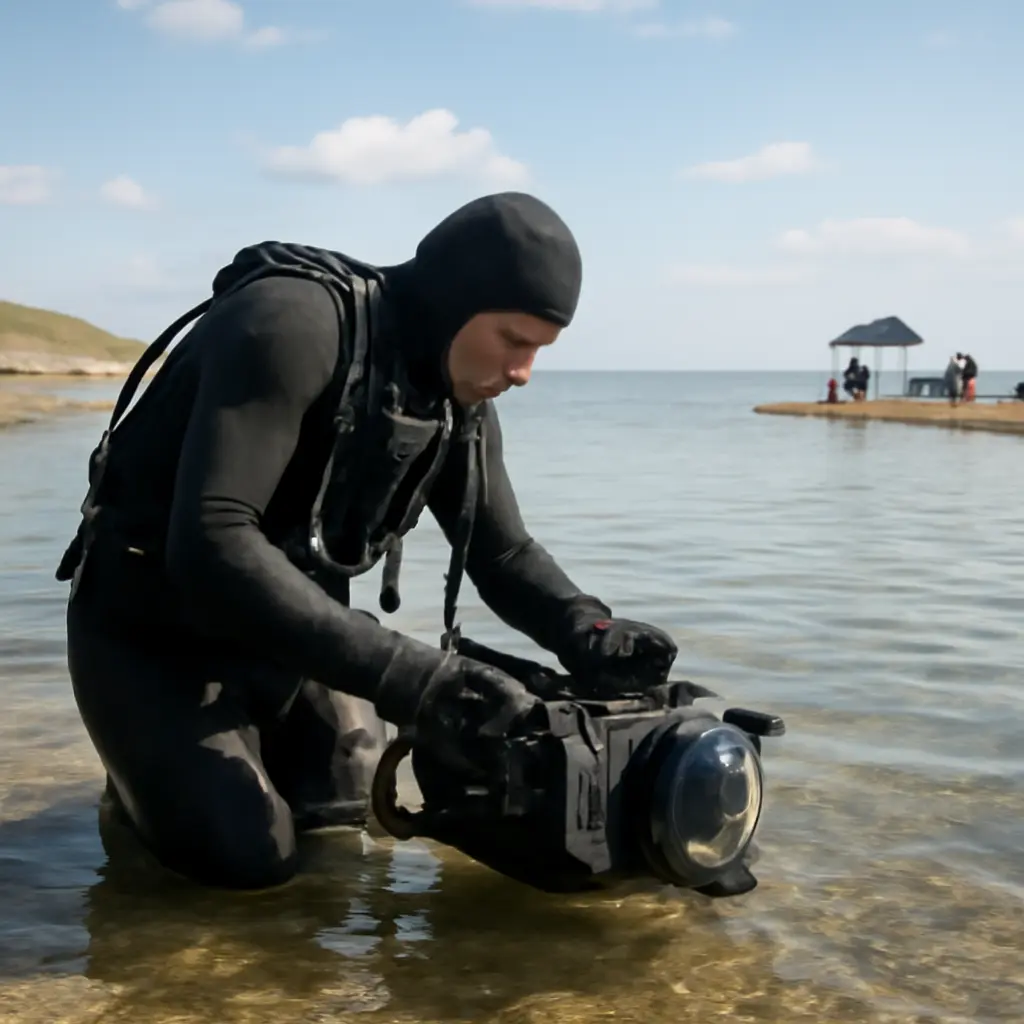
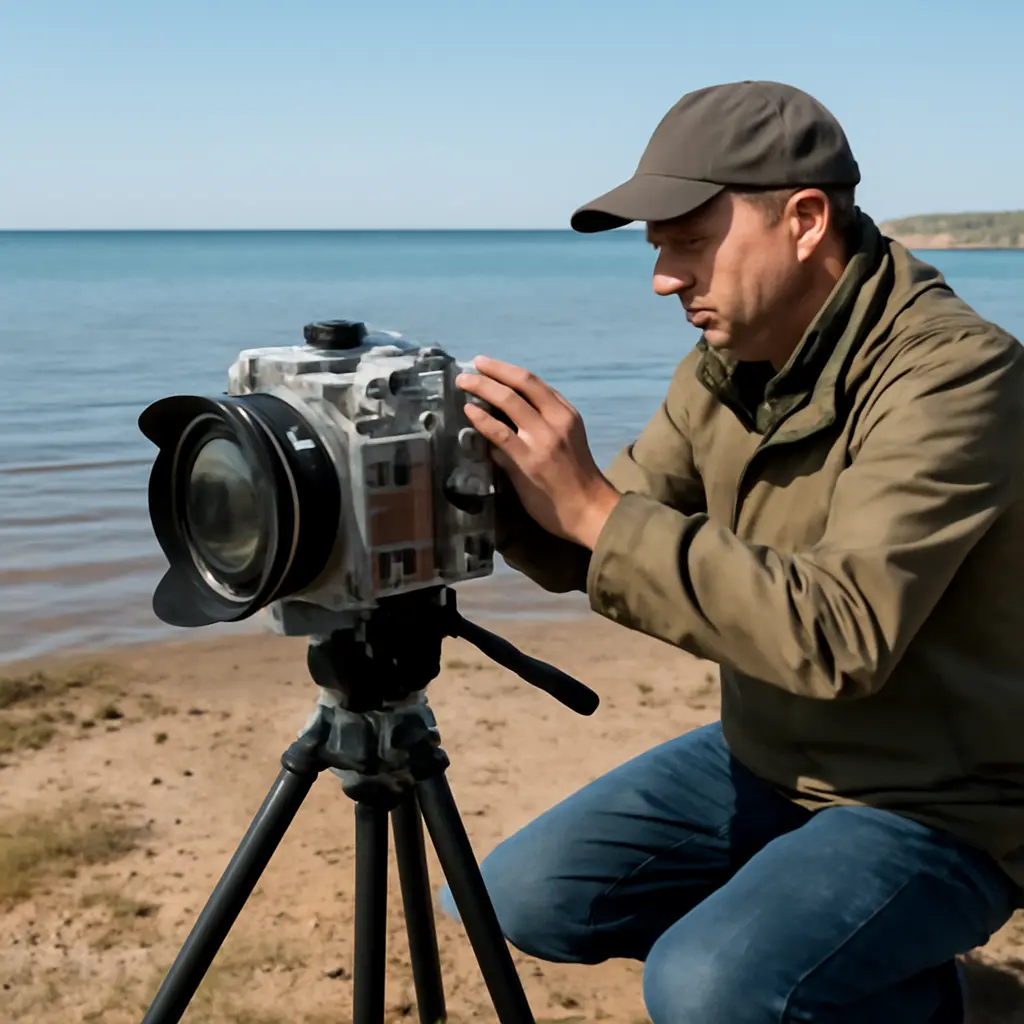
A camera housing is a sealed enclosure that protects equipment from water and pressure. Its safe operating depth depends on the specific housing, maintenance, and manufacturer rating; no general depth figure should be treated as universal. Before a shoot, crews should inspect seals, check latches, test the housing without valuable camera equipment when appropriate, and follow manufacturer limits. The American Academy of Underwater Sciences emphasizes training and established procedures for scientific diving; film productions can apply the same principle by assigning qualified people to equipment checks and underwater operations.
Lighting, color correction, and shot design
Underwater lighting has to account for distance, water clarity, and the color that remains available at the subject. Bringing a light closer is often more effective than increasing power from far away, because illumination is lost with distance and scattered by particles. Wide shots may depend on ambient light and silhouettes, while close-ups can use carefully positioned lights to restore color and texture. The most reliable approach is to test the intended lens, housing port, light placement, and camera settings in the actual water conditions before the principal shoot.
Safety, weather, and continuity
Water filming can involve drowning hazards, cold exposure, currents, slippery surfaces, electrical risks, and changing weather. The U.S. Coast Guard’s boating safety guidance and occupational safety practices both reinforce the importance of planning, suitable protective equipment, and competent supervision. Productions should appoint a designated water-safety lead, use qualified divers where required, establish entry and exit points, maintain communications, and stop work when conditions exceed the plan. For continuity, record tide and current conditions, water temperature, visibility, weather, and the state of wet costumes or props. These measures protect people and also reduce costly interruptions.
Water creates distinct cinematic approaches
Filmmakers do not need to put every camera underwater to make water central to a scene. Surface photography, rain effects, tanks, miniatures, and digital compositing offer different balances of realism, control, and cost. Choosing among them depends on the desired image, available locations, and the risks a production can responsibly manage.
Underwater cinematography
Underwater cinematography places the camera below the surface, allowing audiences to experience submerged movement and perspective directly. It is suited to marine life, swimming scenes, and images of weightlessness, but requires specialist housings, trained operators, and careful control of visibility and safety. The underwater sequences in films such as “The Abyss” illustrate how submerged settings can shape atmosphere and performance as much as scenery. Such productions also show why underwater shots are planned around camera movement, actor comfort, and the logistics of breathing and communication.
Surface and split-level shots
A split-level shot shows both above and below the waterline in one frame. It is visually compelling because the camera must manage two different optical environments at once: air above the surface and water below it. A large dome port, controlled water movement, and careful focus can help, but droplets and uneven lighting can complicate the image. This approach is useful for transitions between worlds—such as a swimmer breaking the surface—when a cut would feel less immediate.
Rain, tanks, and controlled water effects
Rain towers, wet-downs, studio tanks, and water-filled sets provide more control than many natural locations. A controlled setup can make it easier to repeat an action, maintain lighting, and protect a schedule from tides or weather. However, artificial rain must be lit to remain visible on camera, and wet surfaces introduce slip and electrical hazards. Productions should distinguish carefully between water used as a visual effect and water used as a real environment: the former may be controlled, but it still requires engineering and safety oversight.
Conclusion: water changes both the image and the production
Water changes filmmaking through refraction, color loss, turbidity, buoyancy, waves, and sound transmission. Those same properties create expressive images—from drifting underwater movement to fractured surface reflections—but require specialized optics, lighting, sound planning, and safety procedures. Whether a production films beneath the surface, at the waterline, or in a controlled rain set, the strongest results begin with testing conditions and protecting the crew. Filmmakers planning water work should consult qualified aquatic-safety professionals, verify equipment ratings, and treat environmental conditions as part of the camera plan.
Sources: National Oceanic and Atmospheric Administration, How Much Water Is in the Ocean?, https://oceanservice.noaa.gov/facts/oceanwater.html; U.S. Bureau of Labor Statistics, National Census of Fatal Occupational Injuries in 2023, https://www.bls.gov/news.release/archives/cfoi_12192024.htm; American Academy of Underwater Sciences, Standards for Scientific Diving, https://www.aaus.org/AAUS/Standards/AAUS/Standards.aspx; National Oceanic and Atmospheric Administration, Ocean Light and Visibility resources, https://oceanservice.noaa.gov/; U.S. Geological Survey, Turbidity and Water, https://www.usgs.gov/special-topics/water-science-school/science/turbidity-and-water; National Park Service, Underwater Sound and Aquatic Environments, https://www.nps.gov/subjects/sound/underwater-sound.htm; U.S. Coast Guard, Boating Safety, https://www.uscgboating.org/