Filming on land and filming underwater use the same basic tools—cameras, lenses, lighting, sound recording, and a crew—but the environment changes how each tool works. On land, filmmakers usually manage weather, terrain, and ambient light; underwater, they must also manage pressure, limited visibility, color loss, buoyancy, and the safety of people working in a life-supporting environment. These differences affect costs, schedules, image quality, sound, and crew training. Understanding them helps filmmakers plan realistic shoots, whether they are recording a landscape, a pool scene, or marine life.
Filming Conditions Define the Differences Between Land and Underwater Production
A useful way to compare the two forms is to treat filming conditions as the set of physical and logistical factors that shape image capture and production decisions. The National Oceanic and Atmospheric Administration (NOAA) describes water as absorbing and scattering light, while the U.S. National Park Service’s underwater photography guidance explains that water filters colors and reduces contrast with distance. On land, air generally allows light to travel farther with less scattering, though fog, dust, and weather can also reduce visibility.
The difference is significant even in clear water. Red light is absorbed relatively quickly, so underwater scenes can appear blue or green; suspended particles scatter light and create haze, especially when the camera is far from its subject. A camera housing protects equipment from water, but it does not correct those optical effects by itself. The practical categories below—light and color, equipment and movement, sound, and safety—show how environmental conditions translate into distinct production methods.
Light, Color, and Visibility
On land, lighting can be shaped with reflectors, diffusion, flags, and powered fixtures, and crews often have a relatively unobstructed path between light source, subject, and lens. Underwater, both sunlight and artificial light are altered by the water column. NOAA’s ocean-light explanations note that water absorbs different wavelengths at different rates; red and orange tones disappear sooner than blue light. As a result, a brightly colored subject can look muted or monochromatic when filmed at depth or from a distance.
Underwater crews commonly move lights close to the subject and position them away from the camera axis to reduce backscatter—the visible glare caused when light reflects off particles between the lens and subject. White balancing can help restore color in suitable conditions, but it cannot recover wavelengths that are no longer present or remove haze caused by suspended matter. In comparison, land cinematographers may contend with changing daylight, but can often add or reposition lights without first accounting for water absorption and backscatter.
Pressure, Camera Housings, and Buoyancy
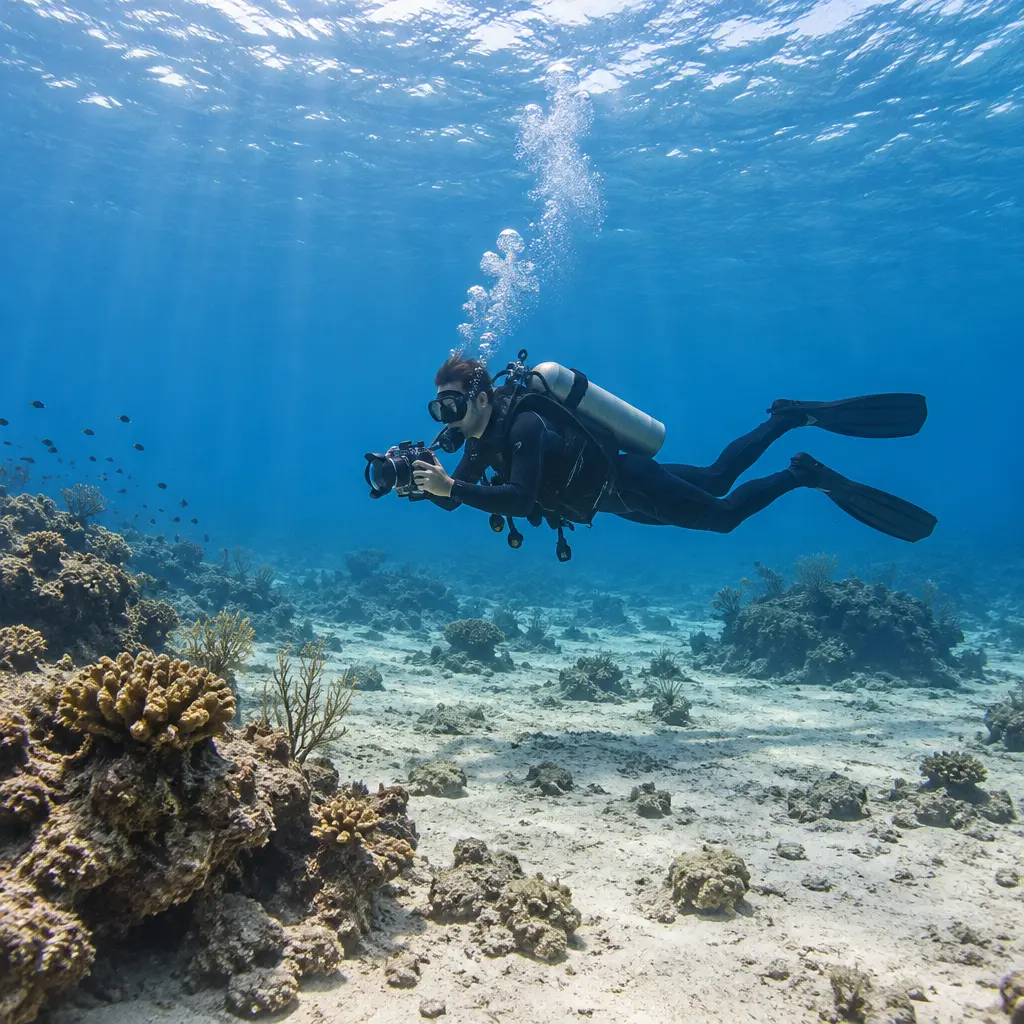
Underwater filming requires a pressure-resistant housing or a camera specifically designed for immersion. The housing must maintain a watertight seal around controls, ports, and connectors, while allowing the operator to adjust settings. Pressure increases with depth: NOAA gives the general oceanographic rule of thumb that pressure rises by about one atmosphere for every 10 meters (33 feet) of seawater. This makes depth rating, maintenance, and pre-dive checks central production concerns, rather than optional equipment considerations.
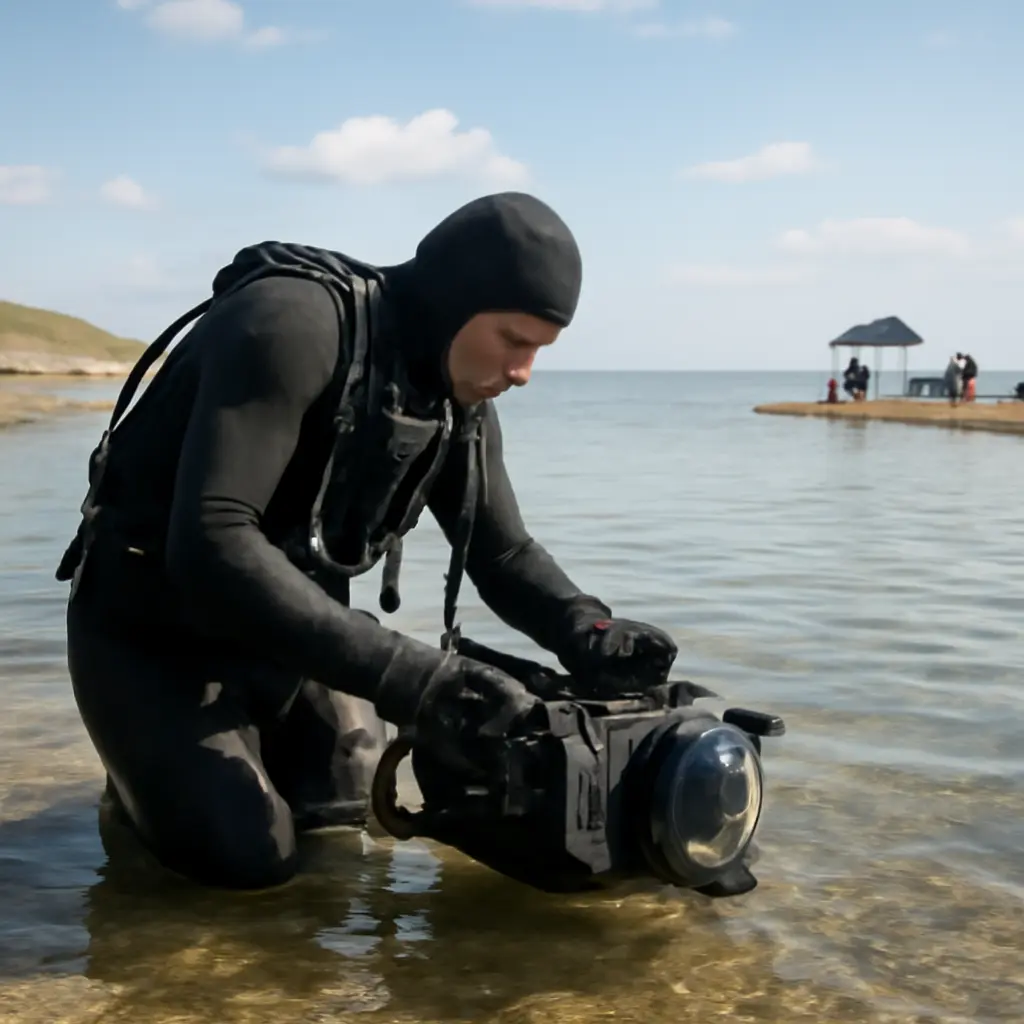
A housing also changes the camera’s handling. Water resistance, added bulk, and buoyancy can make a rig harder to maneuver than a handheld land camera. Crews may add flotation or weights to make a system neutrally buoyant, reducing the effort required to hold a stable frame. On land, gravity and support equipment such as tripods, dollies, and cranes dominate camera movement; underwater, operators must control three-dimensional drift as well as framing and focus.
Movement, Focus, and Framing
Land-based camera movement usually takes place over a firm surface or along a prepared track. Underwater, the camera operator can move vertically as well as horizontally, but currents, breathing bubbles, limited visibility, and the need to maintain safe distance from wildlife can complicate a shot. Water also changes the apparent size and position of objects viewed through a flat port, while dome ports are often used for wide-angle work to manage the optical boundary between water and the lens.
These constraints influence shot design. Underwater scenes often benefit from close camera-to-subject distances because shorter distances reduce the amount of water—and therefore the scattering—between them. On land, a director can more readily use long lenses or place a camera far from a subject without the same water-column haze. In both settings, rehearsals and camera tests matter, but underwater tests must account for the exact housing, port, depth, and available light.
Production Equipment Changes How Filming Works Underwater
Production equipment is the collection of cameras, lenses, lighting, support systems, and recording tools used to capture a scene. Underwater equipment is not simply land equipment placed in a waterproof box: it must be compatible with pressure, water exposure, operator access, and the planned dive. This distinction creates several underwater subtypes, including shallow-water surface filming, scuba-supported filming, remotely operated camera work, and specialized deep-water cinematography.
Camera Systems and Waterproof Housings
A camera housing is an enclosure designed to keep water out while providing access to selected camera controls. Professional housings are made for particular camera bodies and lenses, and their operating depth depends on the manufacturer’s rating and maintenance condition. Before a shoot, crews check seals, inspect ports, test controls, and often perform a water test without the camera. These precautions address a failure mode that has no close equivalent in ordinary land production: water intrusion can destroy expensive electronics and interrupt a dive.
The housing affects lens choice and usability. Some controls may be difficult to reach while wearing gloves, and changing lenses underwater is generally impractical because it risks flooding the system. Land crews can switch lenses or modify camera builds quickly; underwater teams typically decide on the lens, port, focus approach, and recording configuration before entering the water.
Lighting and Power
Underwater lights are built to resist water pressure and prevent leakage around batteries, switches, and cable connections. Their useful range is limited by water clarity: adding power does not necessarily solve the problem if particles between the fixture and subject reflect the light into the lens. Accordingly, underwater cinematographers often prioritize close placement, careful beam control, and restrained lighting rather than simply using the brightest available fixture.
On land, fixtures can be placed on stands, powered from mains electricity or batteries, and repositioned rapidly. Underwater, lights may be mounted on camera arms, held by a diver, or operated remotely. Cables and batteries must be selected for the environment, and any powered equipment requires appropriate waterproofing and operating procedures.
Sound Recording and Communication
Sound behaves differently underwater because sound travels through water much faster than through air, and its direction can be harder for a person to identify. NOAA gives a typical speed of sound in seawater of roughly 1,500 meters per second, compared with about 343 meters per second in air at room temperature. Hydrophones—underwater microphones—are used to record aquatic sounds, while dialogue scenes are often recorded separately or replaced with synchronized narration and post-production sound.
On land, boom microphones and wireless lavalier systems can capture dialogue directly, subject to wind, traffic, and room noise. Underwater, divers cannot speak intelligibly to a conventional microphone, and communication between crew members may depend on hand signals, slates, or specialized underwater communication systems. The sound plan therefore needs to be established before filming, particularly for scenes that combine underwater images with spoken dialogue.
Safety and Scheduling Shape Underwater Filming
Safety planning is a production requirement in both environments, but underwater filming adds dive-related hazards and limits the time people can safely remain submerged. The U.S. Occupational Safety and Health Administration (OSHA) regulates commercial diving under 29 CFR Part 1910, Subpart T, including requirements concerning dive planning, equipment, and personnel. Recreational certification alone does not replace the training, supervision, and procedures required for professional work.
A land shoot may be delayed by weather, access, or daylight; an underwater shoot can also be constrained by depth, decompression obligations, gas supply, water temperature, currents, visibility, and the condition of the crew. These factors make an underwater schedule less flexible and increase the importance of advance planning, contingency time, and a qualified dive team.
Dive Limits and Crew Roles
A dive plan specifies such details as depth, duration, breathing gas, entry and exit points, communications, emergency procedures, and the responsibilities of each diver. The Divers Alert Network (DAN) emphasizes that safe diving depends on appropriate training, equipment, and conservative planning. In a film crew, camera operators may need to divide attention between filming and their own dive status, so productions typically assign qualified support personnel rather than expecting one person to manage every task.
A land camera operator can often continue filming while standing nearby, taking breaks as needed. An underwater operator must monitor remaining gas and dive conditions, and may need to stop filming even when the scene is not complete. The available recording window is therefore tied to dive planning, not only battery capacity or memory-card space.
Wildlife, Locations, and Environmental Care
Underwater productions may work around fragile habitats and animals that can be disturbed by lights, noise, bubbles, or close approaches. NOAA’s marine-life viewing guidance recommends observing wildlife without touching, feeding, chasing, or disrupting it. The same principle informs responsible filming: crews should choose a suitable distance and location, follow protected-area rules, and avoid damaging reefs or seabed environments to obtain a shot.
Land filming also has environmental responsibilities, including wildlife protection and habitat impact, but underwater damage can be difficult to see and may persist after a crew leaves. Location permissions, environmental briefings, and a plan for minimizing contact are therefore part of production logistics, not merely ethical add-ons.
Time, Cost, and Contingency Planning
Underwater shoots generally require additional specialist resources: pressure-rated housings, underwater lighting, dive professionals, safety support, and time for equipment checks and water access. There is no single reliable cost multiplier for comparing all land and underwater productions, because costs depend on depth, location, crew size, equipment, and whether the scene is filmed in a pool, coastal water, or offshore. Still, the extra technical and safety requirements explain why underwater work often needs a more detailed budget and schedule.
A practical production plan includes backup seals and critical equipment, alternate shot lists for poor visibility, and schedule allowances for changing conditions. Land productions also use contingencies, but underwater teams must be prepared for the possibility that a planned shot cannot be completed safely or that visibility changes during the dive.
Real-World Examples Show How Filming Methods Adapt
Examples from documentary and narrative production show that underwater filming is not a single technique. The appropriate method depends on whether the priority is natural behavior, controlled performance, scientific observation, or a visual effect. Comparing these approaches makes clear why a production may combine land footage, underwater photography, and computer-generated imagery rather than attempt every shot in one environment.
Natural-History Filming
Marine documentaries often rely on long observation periods and careful camera placement to record animals behaving naturally. Filmmakers may use long lenses from a vessel for surface activity, then switch to housed cameras or remotely operated systems below the surface. A close, unobtrusive setup can reduce the water between lens and subject and limit disturbance, while remote systems can be useful where a diver’s presence would alter behavior or create a safety concern.
This approach contrasts with many land wildlife shoots, where a camera can be concealed behind a blind or operated from a stable position. Underwater, the camera must also be protected from pressure and currents, and the crew must account for the visibility and duration of each dive.
Controlled Narrative Scenes
Narrative productions may film a controlled water sequence in a pool, where lighting, access, and repeatability are easier to manage than in open water. The scene can be rehearsed with performers and safety divers, and dialogue can be recorded separately. For a shot requiring a view above and below the waterline, a dome port may capture both portions in one frame, though framing and focus require testing because the camera is looking through two different optical environments.
A production can also combine practical water footage with dry-for-wet techniques, in which performers are filmed on land to suggest an underwater scene. This can provide greater control over dialogue, lighting, and performer comfort, but it does not reproduce every movement or visual quality of genuine underwater photography. The choice is a creative and production decision rather than a simple technical substitute.
A Comparison Chart for Planning
The table below summarizes the production implications. It is a planning guide rather than a universal rule: conditions vary with location, equipment, and the shot being made.
| Production factor | Filming on land | Filming underwater |
|---|---|---|
| Light and color | Often shaped with standard fixtures and reflectors; weather and ambient light remain important. | Water absorbs and scatters light; color loss and backscatter require close, carefully positioned lighting. |
| Camera protection | Weather protection may be needed, but a pressure-rated housing is usually not. | Requires a suitable waterproof housing or camera with a depth rating, plus seal checks. |
| Camera movement | Usually supported by ground, tracks, cranes, or handheld operation. | Three-dimensional movement, buoyancy, and currents affect stability and framing. |
| Sound | Dialogue can be recorded with boom and wireless microphones. | Hydrophones capture underwater sound; dialogue and crew communication need special planning. |
| Schedule | Often shaped by access, weather, light, and crew availability. | Also shaped by dive limits, depth, gas supply, visibility, currents, and safety procedures. |
| Environmental care | Protect locations, wildlife, and habitats from disturbance or damage. | Also avoid contact with sensitive habitats and disturbance to aquatic wildlife. |
Conclusion: Filming Conditions Determine the Production Approach
The differences between filming on land and filming underwater begin with the environment and extend through every stage of production. Water changes light, color, sound, camera handling, and visibility; pressure requires specialized housings; buoyancy and currents complicate movement; and dive safety limits the time available to capture a shot. Land filming has its own constraints, but it generally offers easier access to equipment, dialogue recording, and continuous camera operation.
For filmmakers, the practical lesson is to design the shot around the environment rather than treat underwater work as ordinary filming with a waterproof camera. Consult qualified dive professionals, test the complete camera and lighting setup, plan for environmental care, and build safety and visibility contingencies into the schedule. Further reading from NOAA, OSHA, and DAN can help crews understand the scientific and operational principles behind responsible underwater production.
Sources: National Oceanic and Atmospheric Administration, Ocean Exploration: Ocean Sound, https://oceanexplorer.noaa.gov/facts/sound.html; National Oceanic and Atmospheric Administration, Ocean Exploration: Light and Color in the Ocean, https://oceanexplorer.noaa.gov/facts/light.html; National Oceanic and Atmospheric Administration, Ocean Exploration: Pressure, https://oceanexplorer.noaa.gov/facts/pressure.html; U.S. National Park Service, Underwater Photography, https://www.nps.gov/articles/000/underwater-photography.htm; U.S. Occupational Safety and Health Administration, Commercial Diving Operations, 29 CFR Part 1910, Subpart T, https://www.osha.gov/laws-regs/regulations/standardnumber/1910/1910SubpartT; Divers Alert Network, Diving Safety, https://dan.org/safety-prevention/; National Oceanic and Atmospheric Administration, Marine Life Viewing Guidelines, https://oceanservice.noaa.gov/ocean/observations/marine-life-viewing.html.