Underwater cinematography is the craft of capturing moving images beneath the water’s surface, where refraction, buoyancy, limited light, and equipment pressure change how cameras and crews work. It combines specialized housings and lighting with careful control of focus, color, movement, and diver safety. The challenge is measurable: water absorbs and scatters light, with red wavelengths disappearing first, while pressure increases by about one atmosphere for every 10 meters of seawater. Understanding these conditions explains why underwater productions rely on purpose-built camera systems, planned lighting and color correction, controlled camera movement, and rigorous safety procedures.
Underwater cinematography depends on optical conditions and camera systems
Underwater cinematography is the recording of film or digital video below the water surface using equipment and methods adapted to submersion. The U.S. National Oceanic and Atmospheric Administration (NOAA) explains that water absorbs and scatters light, reducing visibility and altering color; the effect depends on water clarity, depth, and the light source. In practical terms, underwater image-making is not simply ordinary filming inside a waterproof box: it requires decisions about optics, housing, illumination, camera movement, and the environment.
Refraction changes framing and focus
Refraction is the bending of light as it passes between materials, such as water, a housing port, and air. A flat port can make a lens appear to have a narrower field of view underwater and can introduce apparent magnification. A dome port helps preserve a wide-angle lens’s field of view by creating an air space in front of the lens, but it requires correct positioning and focus. These differences matter when matching a planned composition, judging subject distance, or keeping a wide-angle scene sharp.
Water filters light and color
Water absorbs longer wavelengths, including red, more quickly than blue and green. As a result, a brightly colored subject may look muted or blue-green as distance or depth increases. NOAA’s ocean-color guidance describes how water and particles affect the light that travels through the ocean and returns to a camera or sensor. Cinematographers compensate by filming closer to subjects, choosing suitable white balance, adding artificial light, and grading footage carefully. These methods cannot fully restore information that never reached the sensor, making distance and lighting fundamental image-quality choices.
Pressure makes the housing a critical system
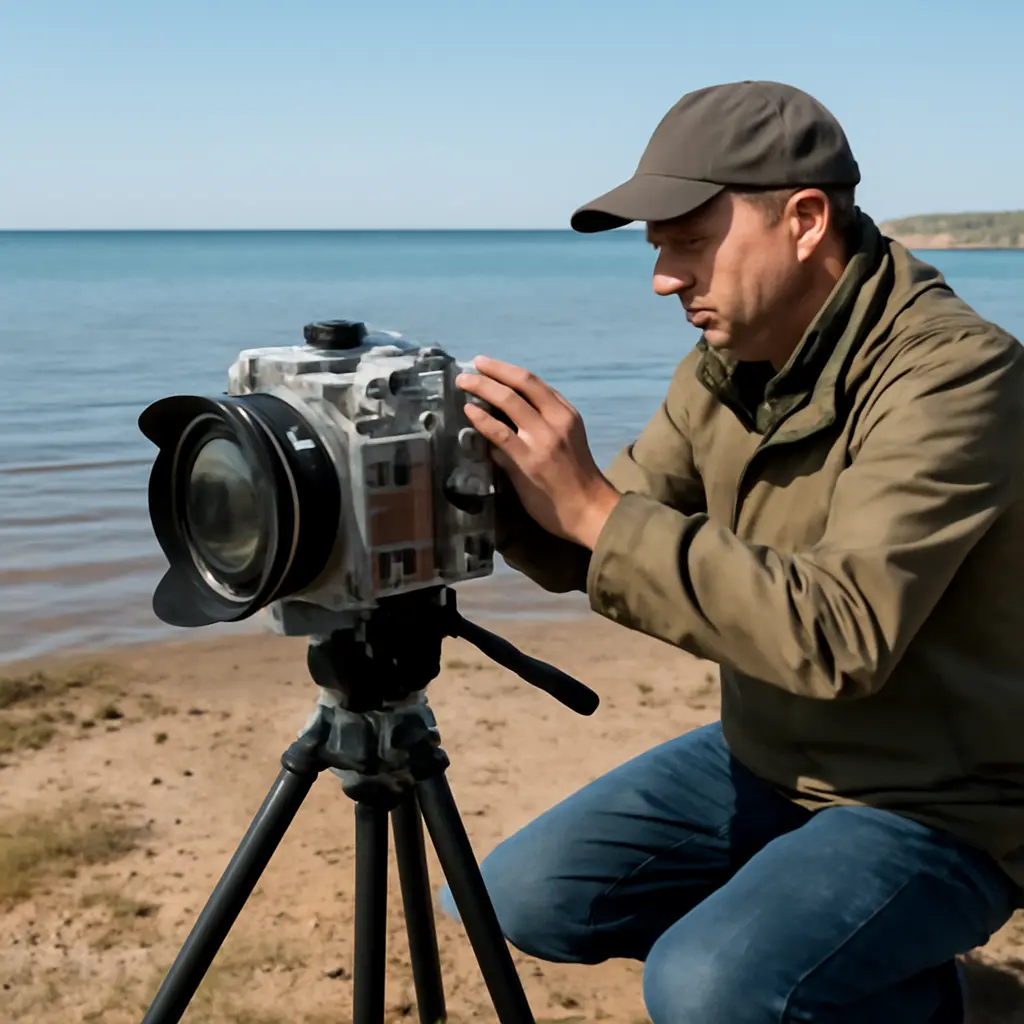
A camera housing is a pressure-resistant enclosure that keeps water away from the camera while allowing access to controls and the lens. Pressure rises by roughly one atmosphere for each 10 meters of seawater, according to NOAA diving references. At depth, that pressure loads the housing, port, seals, and controls; a leak can damage equipment and end a shoot. Crews therefore use housings rated for the planned depth, inspect and maintain O-rings, test equipment before deployment, and follow the manufacturer’s limits. The housing is part of the imaging system, not merely an accessory.
Underwater cinematography uses distinct camera and lighting approaches
Once the optical and pressure constraints are understood, productions select a method suited to the location, subject, and desired look. The main approaches include natural-light filming, artificial-light filming, and remotely operated or specialist camera systems. Each balances image quality against access, safety, cost, and the disturbance a crew may cause.
Natural-light cinematography
Natural-light cinematography uses sunlight entering the water, often for wide scenes, shallow reefs, or silhouettes against the surface. It avoids carrying large lights and can preserve an expansive sense of place. Its limitations are changing weather, surface conditions, depth, and time of day. Because color and brightness decline with distance through water, crews often work during favorable daylight and keep the camera close to the subject. A graduated neutral-density filter or careful exposure choices may help balance a bright surface with darker underwater areas, but cannot overcome poor visibility.
Artificial lighting and color restoration
Underwater lights—typically continuous LED units or, for still photography, strobes—restore illumination and color on nearby subjects. Their useful range is limited: particles in the water can reflect light back toward the lens, creating backscatter. To reduce it, cinematographers may position lights away from the lens axis, use beams that illuminate the subject rather than the water between camera and subject, and avoid unnecessary lighting in turbid conditions. White balance and post-production color grading refine the captured image, but lighting, subject distance, and water clarity determine how much usable detail is recorded in the first place.
Remote and specialist camera systems
Remotely operated vehicles (ROVs), fixed underwater camera rigs, and pole or robotic systems can capture scenes that are too deep, hazardous, or inaccessible for a camera operator. NOAA describes ROVs as unoccupied, tethered underwater vehicles operated from a surface vessel; they can carry cameras and lights for exploration and documentation. Such systems may provide stable, repeatable movement and reduce diver exposure, but their size, tether, noise, and maneuverability can affect where and how they are used. A specialist rig is chosen according to the environment and shot, rather than as a universal substitute for a diver-operated camera.
Underwater cinematography controls movement, focus, and composition
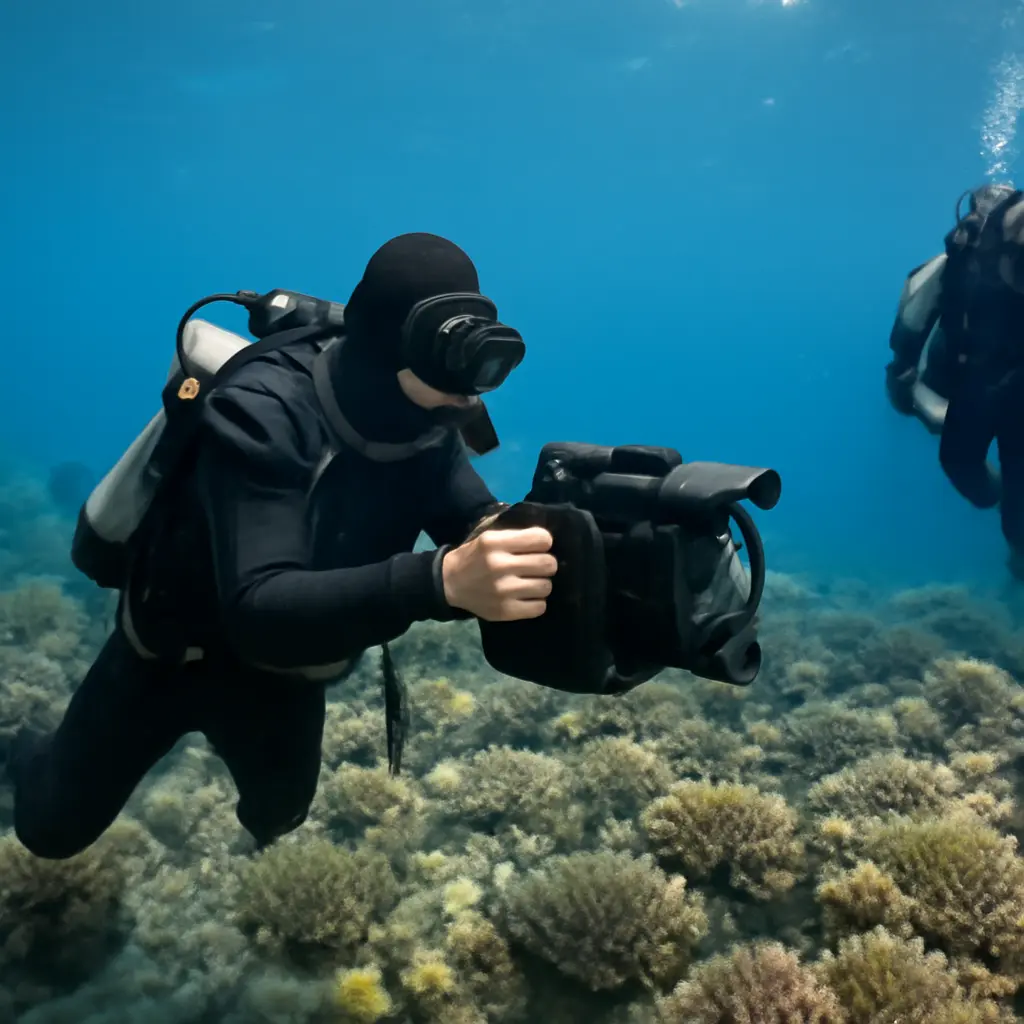
Underwater camera operation is shaped by buoyancy and drag as much as by conventional cinematographic technique. A camera operator must manage trim, position, and breathing while keeping the frame steady and avoiding contact with the bottom or marine life. The strongest results usually come from pre-planned movement and close collaboration between the camera team and dive team.
Buoyancy and camera stabilization
Buoyancy control is the ability to remain at a chosen depth without uncontrolled ascent or descent. A camera rig changes a diver’s balance and may create drag, so operators often adjust the rig’s flotation and test its handling before filming. Stabilization may come from the operator’s technique, a supported rig, a compact underwater gimbal, or a remotely operated platform. Movement should be deliberate: sudden fin kicks can stir sediment, while contact with reefs can damage fragile habitat. For documentary and wildlife work, a stable, restrained camera is often both a visual and an environmental advantage.
Focus, lens choice, and subject distance
Focus and lens selection are closely linked to visibility. Wide-angle lenses are commonly useful underwater because they allow the camera to approach a subject while still including its surroundings; the shorter water path can improve contrast and color. Macro lenses are suited to small subjects but demand precise focus and careful lighting. Autofocus may struggle with low contrast, suspended particles, or moving subjects, so productions may use manual focus, focus lights, or a planned working distance. The best lens is the one that supports the intended shot while keeping the subject close enough for the available visibility and light.
Shot planning and communication
A shot plan defines the intended composition, movement, duration, and crew positions before the team enters the water. Underwater communication may rely on hand signals, slates, line signals, or specialized communications equipment, depending on the dive. Planning is especially important because camera operators have finite gas supplies, exposure limits, and task loading. The Divers Alert Network (DAN) emphasizes that dive planning and conservative practices are central to reducing risk; a cinematic shot should never override a diver’s safety limits or the agreed plan.
Underwater cinematography requires safety and environmental controls
A production underwater is a dive operation as well as a film set. Depth, current, temperature, visibility, entanglement hazards, equipment failure, and limited communication can all affect safety. The risk is managed through qualified personnel, dive planning, equipment checks, emergency procedures, and a clear rule that the shot can be abandoned. Environmental care is equally important: crews should avoid touching wildlife or habitat, keep lights and noise appropriate to the situation, and use remote systems when they offer a safer, less intrusive option.
Dive planning and team roles
A professional plan identifies the dive supervisor or designated safety lead, camera operator, safety diver, surface support, communications method, entry and exit points, and emergency response. The team should agree on depth and time limits, gas reserves, lost-diver procedures, and signals to stop filming. DAN’s safety resources stress preparation and attention to changing conditions; currents, weather, and visibility can shift during a shoot. A camera operator should not be expected to manage cinematography and dive safety alone.
Equipment checks and emergency readiness
Before a dive, crews inspect housing seals, port attachments, batteries, lights, buoyancy, and any cables or tethers. A leak test and a controlled shallow-water check can reveal problems before valuable equipment is taken deeper. Teams also need a plan for flooding, loss of communications, entanglement, or a diver who must end the dive. The exact checklist depends on the housing and dive operation, so manufacturer guidance and recognized diving procedures take precedence over generic advice.
Wildlife and habitat protection
Responsible filming minimizes disturbance: maintain distance, avoid chasing or feeding animals, do not touch or stand on reefs, and limit repeated approaches. The National Park Service’s guidance for coral reefs emphasizes that coral is living, fragile habitat; even accidental contact can cause damage. In wildlife sequences, patience and positioning are preferable to forcing an interaction. Productions should also follow local permits and protected-area rules, particularly when using lights, vessels, drones, or remotely operated equipment.
Underwater cinematography has changed with technology and practice
The field has evolved from bulky, specialized film systems toward compact digital cameras, high-capacity housings, efficient LEDs, and remotely operated platforms. The underlying physics has not changed, but smaller cameras and improved monitoring have expanded access to locations and shot types. Historical landmark films and contemporary science projects show how those tools serve different goals: spectacle, storytelling, observation, and research.
From expedition cameras to digital systems
Early underwater motion-picture work required custom pressure-resistant equipment and careful planning, while modern digital cameras can offer high-resolution recording in relatively compact housings. Digital monitoring lets crews review exposure, focus, and framing in the field, but it does not remove limits imposed by light absorption, scattering, or pressure. Improvements in sensors and post-production can help manage color and noise, yet the most reliable gains still come from good visibility, suitable lighting, and thoughtful camera-to-subject distance.
Case study: filming deep-sea environments
Deep-sea cinematography illustrates why remote systems matter. NOAA’s ocean-exploration programs use ROVs to document deep environments that human divers cannot safely reach. Cameras on these vehicles can record organisms, geological features, and research operations while lights reveal subjects in darkness. The resulting footage is both visual material and scientific documentation, although lighting and vehicle presence may influence what is observed. Remote filming therefore requires careful interpretation as well as technical control.
Case study: natural history and conservation storytelling
Natural-history productions often combine wide establishing views, close wildlife behavior, and carefully lit details to make underwater ecosystems legible to audiences. The BBC’s history of Blue Planet II describes the production’s use of advanced filming approaches to capture marine life and habitats. Such work demonstrates that compelling images depend not only on camera technology but also on access, patience, specialist expertise, and ethical decisions about how close a crew should approach an animal or habitat.
Conclusion: underwater cinematography connects image craft with science and safety
Underwater cinematography works by adapting camera systems and filmmaking decisions to water’s optical behavior and pressure. Refraction affects lens choice and framing; absorption and scattering shape color, contrast, and usable distance; housings protect equipment; and lighting, buoyancy, focus, and shot planning determine whether the image is both effective and safe to capture. Natural-light, artificially lit, and remote approaches each serve different situations. For anyone learning the craft, the most useful next step is to study basic underwater optics alongside recognized dive-safety guidance, then practice with qualified supervision and a strict commitment to protecting marine life.
Sources: National Oceanic and Atmospheric Administration (NOAA), Ocean Exploration: Remotely Operated Vehicles, https://oceanexplorer.noaa.gov/technology/subs/rov/rov.html; National Oceanic and Atmospheric Administration (NOAA), How Deep Is the Ocean?, https://oceanservice.noaa.gov/facts/oceandepth.html; National Oceanic and Atmospheric Administration (NOAA), Ocean Color, https://oceanservice.noaa.gov/facts/ocean-color.html; Divers Alert Network (DAN), Diving Safety, https://dan.org/safety-prevention/; National Park Service, Coral Reefs, https://www.nps.gov/subjects/oceans/coral-reefs.htm; BBC, Blue Planet II, https://www.bbc.com/mediacentre/mediapacks/blue-planet-2/