Camera systems can help property owners spot rising water, leaks, and drainage failures, but cameras alone cannot prevent floods. Camera system maintenance routines are the inspections, cleaning, testing, and repair practices that keep cameras and connected alerts dependable when conditions deteriorate. The National Weather Service reports that floods cause more damage in the United States than any other weather-related event, making early detection valuable. A practical prevention program combines lens and housing care, power and network checks, verified water-level views, and scheduled tests—while treating cameras as one layer alongside sensors, drainage maintenance, and emergency procedures.
Define camera-system maintenance routines for flood prevention
A camera-system maintenance routine is a documented, recurring set of tasks that checks whether cameras, mounts, power supplies, communications, recording, and alerts remain fit for their intended use. This is an operational definition rather than a formal definition issued by one standards body. The National Institute of Standards and Technology’s guidance on operational technology emphasizes that systems controlling or monitoring physical environments require attention to reliability, security, and availability; those principles apply to flood-monitoring cameras as well.
For flood readiness, the relevant camera types include fixed outdoor cameras aimed at drains or waterways, pan-tilt-zoom (PTZ) cameras covering larger areas, thermal cameras used in specialized settings, and network cameras integrated with video management software. A camera gives visual context, but it does not necessarily measure water depth or identify a concealed leak. Pairing video with calibrated water-level, leak, or flow sensors can provide a stronger warning system.
The need is practical as well as technical: NOAA’s National Centers for Environmental Information estimates that U.S. weather and climate disasters with losses exceeding $1 billion have caused more than $2.9 trillion in cumulative damage since 1980, adjusted to 2023 dollars. Not every event is a flood, but the figure illustrates the high cost of hazard-related disruption. Maintenance cannot eliminate flood risk; it can reduce the chance that a preventable equipment failure hides a developing problem.
Visual coverage and camera placement
Coverage means that the camera provides a useful, unobstructed view of the specific locations where water is likely to accumulate or enter. Inspect sightlines to sump pits, floor drains, loading bays, retaining walls, culverts, pump rooms, and known leak points. Confirm that the view still includes a recognizable reference—such as a marked staff gauge or fixed step—so operators can judge changes in water level. A wide view that makes water depth impossible to estimate may be less useful than a targeted view.
Equipment condition and availability
Availability is the ability of the system to provide usable video when it is needed. Check for loose mounts, cracked housings, corroded connectors, failed infrared illumination, damaged cables, fogging, and water ingress. Review recordings—not just the live feed—to ensure the camera is saving footage at the expected rate and retaining it for the required period. NIST’s guidance for operational technology supports a lifecycle approach: document assets, assess risks, maintain configurations, and verify that protective measures continue to work.
These physical and functional checks lead directly to the recurring maintenance tasks that keep the view reliable through changing weather and site conditions.
Maintain camera hardware and image quality
Hardware maintenance preserves the camera’s ability to produce interpretable images. Outdoor equipment faces rain, dust, insects, salt, temperature swings, vibration, and vegetation growth. The U.S. Environmental Protection Agency notes that stormwater can carry pollutants from surfaces into waterways; in facilities, runoff and splash can also leave residue that degrades a lens or housing. Maintenance frequency should reflect exposure, manufacturer instructions, and the consequences of losing coverage—not a single universal calendar.
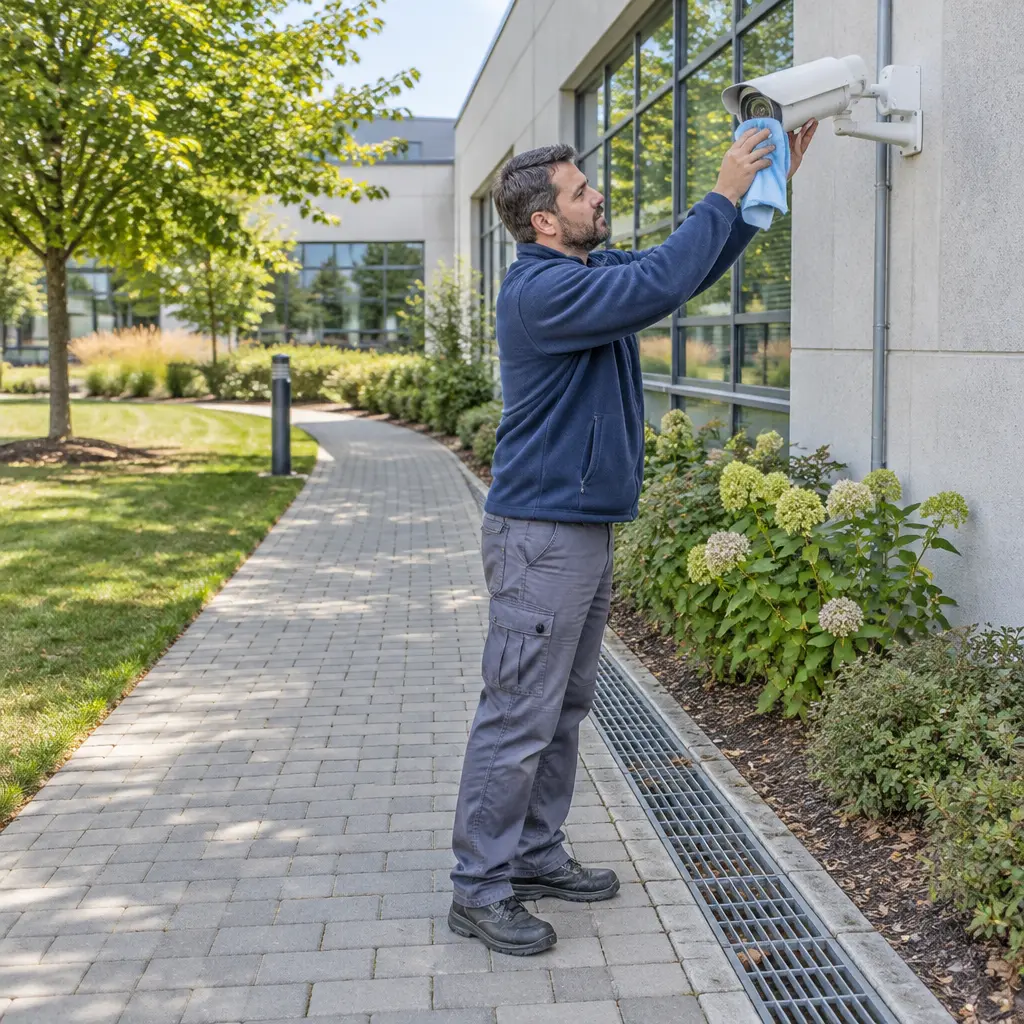
Clean lenses, windows, and protective housings
Lens cleaning removes grime, water spots, spiderwebs, and condensation that can obscure small changes in water level. Use cleaning materials approved by the equipment manufacturer, inspect seals, and verify that protective windows are not scratched or clouded. After cleaning, compare a daytime and low-light image with a known-good reference. Avoid directing high-pressure water at seals or connectors, since cleaning can itself introduce moisture damage.
Inspect mounts, cables, and environmental protection
A secure mount prevents wind or vibration from shifting the camera away from a drain or gauge. Check fasteners, brackets, cable glands, conduit, junction boxes, and drip loops, and look for corrosion or signs of pest damage. Confirm that the installation’s ingress-protection rating and temperature range suit the location. Any damaged seal or exposed connection should be handled by qualified personnel under the site’s electrical-safety procedures.
Verify lighting, focus, and image settings
Image validation confirms that the camera can distinguish relevant features in both ordinary and adverse conditions. Test focus, exposure, infrared or supplementary lighting, glare from wet surfaces, and night imagery. If analytics detect water, confirm that reflections, shadows, rain streaks, and moving vegetation do not routinely trigger false alarms or mask real changes. Keep a dated sample image so staff can recognize gradual loss of clarity or a shifted field of view.
Test power, connectivity, recording, and alerts
A clear picture is not enough if the camera loses power, cannot transmit video, or fails to notify the people responsible for response. Reliability testing should follow the complete path from camera to display, storage, monitoring station, and alert recipient. The Cybersecurity and Infrastructure Security Agency advises organizations to plan for resilience in critical systems; for flood monitoring, this means considering backup power, alternate communications, access controls, and documented recovery steps.
Check power and backup operation
Inspect power supplies, battery condition, surge protection, and uninterruptible power supplies (UPS), where installed. Confirm that a brief power interruption does not leave the camera offline or erase required settings. Test backup arrangements according to the manufacturer’s instructions and site safety rules. A UPS only supports equipment within its capacity and runtime; it should not be treated as a substitute for a generator or other site-level continuity plan where longer outages are possible.
Validate network access and recorded footage
Connectivity checks confirm that authorized users can view the stream and that recordings are being stored correctly. Review network status, time synchronization, storage capacity, camera credentials, and retention settings. Test access from the locations where staff will actually respond, including an approved remote connection if used. Because network cameras are connected devices, apply security updates through change-control procedures, restrict access to authorized accounts, and remove default or unused credentials.
Exercise alert delivery and escalation
An alert test verifies that a meaningful event reaches a person who can act. Simulate a camera outage or a sensor threshold under controlled conditions, then confirm receipt, acknowledgement, escalation, and logging. Establish named primary and backup contacts, including after-hours coverage. Cameras may support visual verification, but automated water-level or leak sensors should drive threshold alerts when measurable quantities are required. A camera’s analytics should not be assumed to detect every flood condition unless validated for that specific scene.
Integrate cameras with drainage and flood-response routines
Camera maintenance is most effective when integrated with physical flood controls. FEMA’s hazard-mitigation guidance emphasizes assessing local hazards and reducing exposure through appropriate protective measures. For a building or site, that may include clearing drains, inspecting sump pumps and backflow devices, maintaining grading, and ensuring that staff know how to respond to warnings. Video provides situational awareness; it does not clear a blocked drain or stop water entering a structure.
Coordinate camera views with drainage inspections
Use cameras to observe selected high-risk locations before and during inspections, then physically verify conditions that cannot be established from video. Keep vegetation, stored materials, and temporary equipment from blocking views or drainage paths. After heavy rain, check whether water receded as expected and record persistent ponding or repeated surcharge for follow-up. Site-specific rainfall thresholds can help trigger inspections, but they should be set using local drainage design, historical experience, and professional assessment rather than copied from a generic checklist.
Pair video with water and leak sensors
A hybrid system combines a camera’s visual context with sensors that measure a condition directly. A float switch, ultrasonic level sensor, pressure transducer, or point leak detector can trigger an alert, while video helps an operator determine whether water is rising, a pump is operating, or access is safe. Sensor calibration, placement, and testing are essential; a poorly located sensor can fail to represent the hazard even if the camera works perfectly.
Document response procedures and limitations
A response procedure states who checks an alert, what evidence is recorded, when to call facilities staff or emergency services, and which areas must not be entered. It should explain known camera blind spots, expected behavior during power or network loss, and how staff verify conditions in person without taking unnecessary risks. FEMA and local emergency-management agencies provide preparedness resources that can help organizations align monitoring plans with broader evacuation and continuity procedures.
Build a risk-based inspection schedule and maintenance record
A risk-based schedule assigns inspection frequency according to exposure, failure consequences, and the time needed to detect and correct a defect. There is no defensible one-size-fits-all interval for every camera. A sheltered interior camera may need less frequent cleaning than one beside a salt-exposed shoreline or dusty construction site. Manufacturers’ maintenance instructions, site risk assessments, and local weather conditions should guide the final schedule.
Use routine, seasonal, and event-triggered checks
Routine checks can include confirming live views and recording status; seasonal checks can address vegetation, storm preparation, heating or cooling concerns, and battery condition; event-triggered checks can follow severe weather, construction, an outage, or an alarm. The table below is a planning example, not a substitute for manufacturer instructions or a site-specific risk assessment.
Example maintenance matrix:
- Each operating day or shift: confirm camera availability, time stamp, and critical alert status.
- Monthly: review image clarity, recording continuity, storage, user access, and alarm-test results.
- Seasonally: clean exposed equipment, inspect mounts and seals, confirm field of view, and check backup power.
- After severe weather or site work: inspect for movement, debris, water intrusion, cable damage, and blocked views.
- At least annually, or as required by the equipment maker: conduct a documented end-to-end system test and review response contacts.
Keep records that reveal recurring failure
A maintenance log records the asset identifier, date, test performed, result, defect, repair, responsible person, and follow-up date. Include representative images and note changes to camera position, software, network, or alert thresholds. Reviewing these records can reveal patterns—for example, repeated lens fogging after temperature changes or recurring outages during storms—and support a targeted fix instead of repeated temporary repairs.
Use performance measures without overstating protection
Useful measures include the percentage of scheduled checks completed, camera uptime, alert-delivery success, time to acknowledge an alarm, and the number of unresolved defects. These metrics describe system performance, not the probability that flooding will be prevented. Pair them with outcome reviews such as time to identify water intrusion, repeated ponding locations, and corrective actions completed.
Conclusion: Maintain cameras as one layer of flood readiness
Camera-system maintenance routines support flood readiness by preserving useful views, dependable power and connectivity, continuous recording, and verified alerts. The strongest program combines those checks with drainage and pump inspections, water-level or leak sensors, cybersecurity practices, and clear response roles. Since cameras cannot prevent rainfall, overcome every blind spot, or replace physical mitigation, their value depends on honest limitations and regular testing. Review the cameras covering your highest-risk areas, schedule a documented end-to-end test, and coordinate findings with facility maintenance and local emergency-planning guidance.
Sources: National Weather Service, Flood Safety, https://www.weather.gov/safety/flood; NOAA National Centers for Environmental Information, U.S. Billion-Dollar Weather and Climate Disasters, https://www.ncei.noaa.gov/access/billions/; National Institute of Standards and Technology, Guide to Operational Technology (OT) Security, Special Publication 800-82 Revision 3, https://csrc.nist.gov/pubs/sp/800/82/r3/final; U.S. Environmental Protection Agency, National Pollutant Discharge Elimination System (NPDES) Stormwater Program, https://www.epa.gov/npdes/npdes-stormwater-program; Cybersecurity and Infrastructure Security Agency, Secure by Design, https://www.cisa.gov/securebydesign; Federal Emergency Management Agency, Hazard Mitigation Planning, https://www.fema.gov/emergency-managers/risk-management/hazard-mitigation-planning